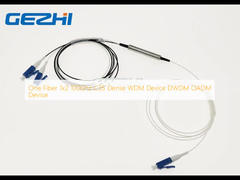
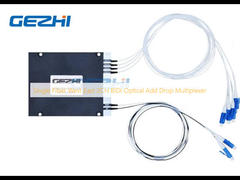
Brief: Join us for a close-up look at this solution and see it in action. In this video, we demonstrate the GEZHI Bidirectional 16 filters 8 CH Optical Add Drop DWDM Module, showing how it enables single-fiber operation for multiplexing and demultiplexing in WDM systems. You'll see its compact LGX plug-in chassis and learn how it selectively adds and drops wavelength channels from a DWDM stream, making it ideal for long haul and metro networks.
Related Product Features:
Enables single-fiber operation for efficient bidirectional data transmission.
Features 8 channels for both West and East sides with 16 total filters.
Utilizes thin film coating technology for C21 to C28 wavelength channels.
Offers low insertion loss of less than 2.5 dB for both add and drop functions.
Provides high isolation with adjacent channels >30 dB and non-adjacent >40 dB.
Supports flexible OADM networking for wavelength routing and channel add/drop.
Packed in a high-density LGX plug-in chassis for easy integration.
Designed for reliable performance in long haul and metro network applications.
Pytania:
What wavelengths does this DWDM module support?
This module supports C21 to C28 wavelength channels, adhering to the ITU-T Grid for DWDM systems with a center wavelength accuracy and 0.8 nm channel passband.
How does the bidirectional feature work in this module?
The module is bidirectional, featuring 8 channels for both West and East sides with 16 filters total, allowing multiplexing and demultiplexing on a single fiber for efficient data transmission in both directions.
What are the key applications for this Optical Add Drop DWDM Module?
It is used in WDM systems for wavelength routing, channel add/drop, long haul networks, metro networks, and dense WDM systems, enabling flexible and high-density optical networking.
What is the insertion loss and isolation performance of this module?
The insertion loss is less than 2.5 dB for both add and drop, with adjacent channel isolation greater than 30 dB and non-adjacent isolation greater than 40 dB, ensuring minimal signal degradation and high performance.